The first part of this was my response to a Daily Writing prompt: take the first line of a book, any book, and use it as the first line of some writing. The second part (starting with "It's an odd sensation...") I wrote out of boredom.
It is said that in death, all things become clear...
Who said that? Somebody dead?
Listen, death is very confusing. It sees no need to tear away the veil of ignorance as you take your last breaths, especially if someone else introduced you to death.
As I lay there, gasping my last, nothing but questions raced through my mind. What had I done to deserve this fate? Why such cruelty?
And when I did die, how would I be able to make that sucker pay for staining the neckline of my new dress?
It's an odd sensation, looking at your dead self. So-called out-of-body experiences have nothing on this. At first it was a bit confusing to grasp: Wait, so, that's me there... but wait, aren't I here? Like, here, here? That's supposed to be there, but that can't possibly be me, I'm... right... here... right?
I spun in circles with that one for quite some time until I finally convinced myself that I was me, and that body that looked like me was just coincidentally similar in features. I was where my thinking was, I told myself, and usually dead bodies can't think for themselves.
That partial detachment made it a bit easier to give in to my curiosity and examine my dead self. The pale face didn't hold too much expression, but the mouth was drawn in a little with worry, and the brow was still wrinkled in concern. I was thankful I didn't die with my eyes open, that would've royally freaked me out. For some reason I'd often been complimented on my neck; apparently there was something regal about it. I half-chuckled spitefully, "Nothing regal about a sliced-open neck, I can say that much." It turned my stomach to look at it, but my curiosity got the better of me: my assailant had taken a few surprisingly deep hacks at my trachea. Below these awfully raw incisions, which I'd decided were as precise as incisions executed by a drunk surgeon on a pogo stick with a rusty machete, now-dried blood laced what had been my collar bone and seeped into the neckline of the dress I was wearing.
And to think, I realized, I'd been trying to pick out a necklace before I died.
26 January 2010

03 January 2010
Dystopian Barbershop
[to be done in a lively barbershop style. Regular text is the lead voice, anything in parentheses is the other three voices. All rhythm and harmony under the lead is done in typical barbershop "bops", "oohs", and "ahhs". Finger snaps are optional.]
A new world order's taken hold
(ooh, new order's taken hold)
Promised all they had hearts of gold
(bah bah, heart of gold!)
Took a little walk down the gov'ner's street,
And they took the power in a coup so neat.
Assured us all it was gonna be fine,
But then sent all our liberties to the bread line
(That bread, bread line!)
Made some big changes to the way we live
(Every night at eight they lock us in)
Everything is watched, that's no way to live.
(Oh no, no way to live)
Music ain't free, they say it just won't do,
So if they found us out, then we'd be through.
No more barbershop, ain't that a shame?
We got this dystopia to blame.
(Dystopian government we have to blame)
Waitin' and lookin', tryin' us to find,
(we're in hiding, trying us to find)
But just thus far to us they're blind
(Just like bats, they're just so blind).
We're hoping we can shake'm, keep ourselves alive
(Livin' and breathing, keep ourselves alive)
And keep the barbershop tradition buzzin in the hive
(Buzzin like bees, keepin' tradition alive)

A new world order's taken hold
(ooh, new order's taken hold)
Promised all they had hearts of gold
(bah bah, heart of gold!)
Took a little walk down the gov'ner's street,
And they took the power in a coup so neat.
Assured us all it was gonna be fine,
But then sent all our liberties to the bread line
(That bread, bread line!)
Made some big changes to the way we live
(Every night at eight they lock us in)
Everything is watched, that's no way to live.
(Oh no, no way to live)
Music ain't free, they say it just won't do,
So if they found us out, then we'd be through.
No more barbershop, ain't that a shame?
We got this dystopia to blame.
(Dystopian government we have to blame)
Waitin' and lookin', tryin' us to find,
(we're in hiding, trying us to find)
But just thus far to us they're blind
(Just like bats, they're just so blind).
We're hoping we can shake'm, keep ourselves alive
(Livin' and breathing, keep ourselves alive)
And keep the barbershop tradition buzzin in the hive
(Buzzin like bees, keepin' tradition alive)
- - - - - -
I asked for a random prompt, the supplier gave me "dystopian barber shop." I interpreted it to be "barbershop" as in the kind of quartet; this one was a thinker, lemme tell you.
I think this stands as proof as to why I shouldn't write "late" at night.
12 December 2009
Random Apostrophic Letters from the Pianist
A take off of a semi-feature on Robyn's blog...
- - - - -
Dear Connor,
It's been a while, I know. I want to continue your story, but you've been out of my head for a while. Please, will you come back? I really do miss you. You and this story of yours has been too enjoyable for you to stay out much longer. If you need a break, I understand, but can you at least assure me you'll come back sometime in the foreseeable future?
Missing you,
~g2
A telegram addressed to My Living Quarters:
Enough is enough. Stop. Upon my return this evening prepare for an intense excavation. Stop. Although I will be exhausted from my piano lesson no mercy will be shown. Stop.
You have been warned. Stop.
Querida amiga,
He pensado mucho en tí recientamente. Mientras sienta un poquitin raro en una parte de mi mente que estás con alguien, estoy alegre para tí. El es inteligente, maduro, y fuerte y franco en sus opiniones, y son buenas calidades, pienso. Las fallas solas que puedo encontrar en él: lleva casi demaciado negro, y a veces habla entre dientes. Pero, no son detalles enormes, creo. Espero que cosas pasen bien para ustedes. De todos modos digo que has escogido bien.
Siempre aquí,
~g2
PS: Yay for chances to use subjunctive! ^^
My dearest Oliver,
Thank you so much for helping me prepare everything: the competition a few weeks ago, my audition yesterday, and the other auditions to come. I'll certainly miss you next year, but I'll be close enough that I can come home to you easily.
Between you and The Piano Teacher I can't thank you enough. You two have been all too good to me.
Much love,
~g2
To: Gen. Nonsense
First, I've some disappointing news to report. I've done some digging, and I believe that majors are indeed higher than captains. I admit that it's a bit disheartening to think that Disaster, Third, and especially Distraction are all ahead of me... and to think! I'm the oldest in the rank! Ah well, it is what it is.
Second, as far as chronicling our group goes: I was thinking we could describe the members and then decide on various episodic adventures. We can brainstorm, yes?
Third: bink.
~Cpt. Obvious
Paulito & Nikki,
I just wanted to thank you guys for being such hoopy writing friends, and indeed hoopy friends in general. Distance may separate us three, but that has yet to be a real deterrent. I've missed talking with you two as of late, but I hope fate decides to allow our paths to cross again very, very soon.
Not panicking,
~g2
- - - - -
Dear Connor,
It's been a while, I know. I want to continue your story, but you've been out of my head for a while. Please, will you come back? I really do miss you. You and this story of yours has been too enjoyable for you to stay out much longer. If you need a break, I understand, but can you at least assure me you'll come back sometime in the foreseeable future?
Missing you,
~g2
A telegram addressed to My Living Quarters:
Enough is enough. Stop. Upon my return this evening prepare for an intense excavation. Stop. Although I will be exhausted from my piano lesson no mercy will be shown. Stop.
You have been warned. Stop.
Querida amiga,
He pensado mucho en tí recientamente. Mientras sienta un poquitin raro en una parte de mi mente que estás con alguien, estoy alegre para tí. El es inteligente, maduro, y fuerte y franco en sus opiniones, y son buenas calidades, pienso. Las fallas solas que puedo encontrar en él: lleva casi demaciado negro, y a veces habla entre dientes. Pero, no son detalles enormes, creo. Espero que cosas pasen bien para ustedes. De todos modos digo que has escogido bien.
Siempre aquí,
~g2
PS: Yay for chances to use subjunctive! ^^
My dearest Oliver,
Thank you so much for helping me prepare everything: the competition a few weeks ago, my audition yesterday, and the other auditions to come. I'll certainly miss you next year, but I'll be close enough that I can come home to you easily.
Between you and The Piano Teacher I can't thank you enough. You two have been all too good to me.
Much love,
~g2
To: Gen. Nonsense
First, I've some disappointing news to report. I've done some digging, and I believe that majors are indeed higher than captains. I admit that it's a bit disheartening to think that Disaster, Third, and especially Distraction are all ahead of me... and to think! I'm the oldest in the rank! Ah well, it is what it is.
Second, as far as chronicling our group goes: I was thinking we could describe the members and then decide on various episodic adventures. We can brainstorm, yes?
Third: bink.
~Cpt. Obvious
Paulito & Nikki,
I just wanted to thank you guys for being such hoopy writing friends, and indeed hoopy friends in general. Distance may separate us three, but that has yet to be a real deterrent. I've missed talking with you two as of late, but I hope fate decides to allow our paths to cross again very, very soon.
Not panicking,
~g2
07 December 2009
On Criticism
I'm not usually one for rants, but with a competition in the not-too-distant past and my college auditions starting up this week (!!!) the subject's been on my mind, asking to be ranted about a bit. And that has been the subject of criticism.

Yes, almost everybody cringes at the word and others in its family (criticize, critic, critique, etc), but I'm pretty well used to it. I have to be, the arts and music especially are subject to such scrutiny.
Whatever the definition, I frankly don't mind it; for the most part it's advice that will help me improve my work, presented in a fairly nurturing way that doesn't label rough spots as FAILURES but as things to work on. Not only that, but more often than not the criticism is given by either a peer or someone who is more experienced than I in a particular area, usually the piano.
Two particular things bother me about criticism, though. Of course there would be something that bothered me about it, otherwise this wouldn't be a particularly good rant.
The first is its negative connotation. According to our good friend N. Webster, the first definition of "criticize" runs as follows:
"crit-i-cize: verb, 1: to consider the merits and demerits of and judge accordingly, evaluate."
I think negative association in the media is to blame for this one. People often times are afraid of having their mistakes pointed out to them, myself included. Folks are also hesitant to point out mistakes to others, for fear of offending them somehow with the criticism. Criticism, while it does point out faults, does not mean that just because one bit needs some work the whole thing is a disaster. It's okay to both be criticized and to criticize...
...to an extent.
I'm hesitant with this because of the other bothersome point. Usually to properly evaluate/critique something, the critic needs equal, comparable, or greater experience in the evaluated field, preferably one of the latter two. Experience gives a critique merit; I'm more likely to give the comments of a piano conservatory professor a little more consideration than the comments of, say, a passing counter clerk with little classical music background. However, some people just slash through others' work without much experience in that particular work.
I automatically think back to our school's talent showcase last year on this subject. After I played, I scooted into the auditorium to see the rest of the acts with a handful of friends. Immediately behind us, however, was somebody who sounded like he was trained by Simon Cowell himself. From the time I sat down to the end of the show, I don't think The Critic had a single positive thing to say about any of the acts. I'm not saying The Critic didn't say anything positive; if TC did say something positive I didn't hear it.
What particularly irked me about this Critic was the tone, the tone of assumed omniscience. Most of the acts were musical groups, and while there's a large musical population in our school, I don't think this particular Critic is among that population. The trouble is, TC commented as if drawing inspiration from some Exhaustive Encyclopaedia of Musical Perfection. Just the condescending tone made me want to whip around and hiss, "then let's see you get up on stage and perform the song that you wrote in front of 70-some-odd people." Unless this person is some kind of closet prodigy with an infinite wealth of knowledge in music composition and performance, because of a lack of experience I honestly don't think The Critic had any right to assume this know-it-all role. It's fine to say why you like or don't like a particular work, but trying to sound like an authority just doesn't cut it.
The right to criticize authoritatively falls under the same rules as bragging rights, in my book: if you can't match it, top it, or offer any advice to improve it, you've no real right to criticize it.
07 November 2009
The Traveler Returns
Howdy all! I just got back from my insanely amazing trip 'round Europe, complete with pictures, commentary, temporal confusion (my body thinks it's three in the morning, but my brain hasn't a zarkin' clue as to location yet, much less time), a touch of aircraft-induced-dizziness (it got bumpy around Greenland), but a great sense of satisfaction.
Will I let you all in on what went down across the pond? Of course! That's what I promised, isn't it? However, all y'all are going to have to hang in some suspence for a while; I still have schoolwork and serious piano catch-up to contend with, as well as actually typing up the aforementioned commentary and loading in the previously-alluded-to pictures. These things take time, you know!
However, I will do my best to deliver as soon as I can!
Will I let you all in on what went down across the pond? Of course! That's what I promised, isn't it? However, all y'all are going to have to hang in some suspence for a while; I still have schoolwork and serious piano catch-up to contend with, as well as actually typing up the aforementioned commentary and loading in the previously-alluded-to pictures. These things take time, you know!
However, I will do my best to deliver as soon as I can!
30 October 2009
DON'T PANIC: It's Just a War of the Worlds
Turn back the clock to late October, 1938. Actor Orson Wells was lining up sci-fi radio plays for his Mercury Theater on the Air. He went through a few ideas, but none of them seemed to be working. Finally, somebody asked "How about this?" and pulled out the book War of the Worlds.
Wells was reluctant to adapt the work to the radio. Not because he was afraid of causing mass hysteria, but because he found the story "dull." The book had been around for 40 years, it had been adapted to several adventure stories and comic books by this time. Most people were familiar with this story, he thought. Finally he agreed to do it. But they had to update it before they went on the air.
 Finally the update cut to a field report in Grover's Mills, where the meteor had landed. The reporter and an astronomer are describing the events unfolding before their eyes: the meteor had fallen away, revealing a metal pod definitely of alien origin. After a few tense moments, the pod begins to open, revealing a hideous slimy creature; muffled shouts could be heard in the background. Then, out of nowhere, the reporter begins to flip out: the creature has just vaporized knot of military personell.

Wells was reluctant to adapt the work to the radio. Not because he was afraid of causing mass hysteria, but because he found the story "dull." The book had been around for 40 years, it had been adapted to several adventure stories and comic books by this time. Most people were familiar with this story, he thought. Finally he agreed to do it. But they had to update it before they went on the air.
Now, fast forward to 8 pm on Sunday, October 30th. A small number of radio listeners tuned into the Mercury Theater on the Air and heard the play's introduction, announcing that night's play as H.G. Wells' War of the Worlds. However, most people were tuned into the immensely popular Chase and Sanborn Hour, and missed the crucial intro. The first four minutes or so went well, but then at approximately 8:05, a rather unpopular singer came on the show. So people began to dial surf, and as it happened most people landed on the Mercury Theater on the Air first, already in progress. But when they landed on it, it sounded like a regular music show. Then, after a little musical interlude, a voice cut in: "We interrupt this program to bring you this news bullitin..."
Now, it should be mentioned at this point that news breaks were fairly new, and extremely frequent, in the late 1930's. Most news breaks at the time ran bullitins having to do with the Nazis, who had been slowly overtaking Europe. Naturally, Americans had been growing nervous about the Nazis, and there were only a few ways to get the news, radio often being the fastest.
The War of the Worlds news break reported that the Princeton Observatory had observed gas explosions on the surface of Mars at regular intervals, but the station would keep the audience updated should anything else be found. "And now back to the music of Raymond Roquello and His Orchestra."
The War of the Worlds news break reported that the Princeton Observatory had observed gas explosions on the surface of Mars at regular intervals, but the station would keep the audience updated should anything else be found. "And now back to the music of Raymond Roquello and His Orchestra."
Most people found this break to be a bit odd. Explosions on Mars? How strange. And who was this Raymond Roquello guy? Not really thinking much of it, folks sat back and relaxed again. But then about a minute later, another news break comes through: The Princeton Observatory had just reported the landing of a meteor in rural Grover's Mills, New Jersey, and had schedualed an interview with one of the Observatory's astronomers.
Now people were starting to get suspicious. What in the world was going on? Most people claimed they didn't believe the story too much, until they heard several "expert" opinions of the situation. The way the show was formatted, with the breaks over the music program, the authoritative commentary, made it sound completely legitament. Folks were lost inside the newscast.
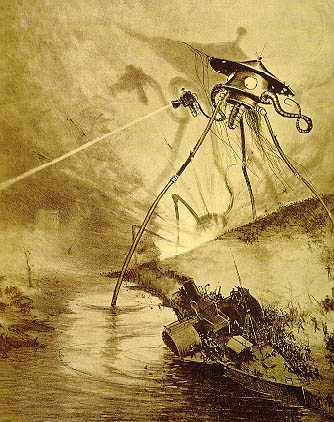 Finally the update cut to a field report in Grover's Mills, where the meteor had landed. The reporter and an astronomer are describing the events unfolding before their eyes: the meteor had fallen away, revealing a metal pod definitely of alien origin. After a few tense moments, the pod begins to open, revealing a hideous slimy creature; muffled shouts could be heard in the background. Then, out of nowhere, the reporter begins to flip out: the creature has just vaporized knot of military personell.
The reporter's panic sounded completely real, and oddly familiar. A year before, many people had heard the now-immortal cry of "Oh, the humanity!" in response to the Hindenburg disaster. The actor playing the reporter had actually found a tape of this report and listened to it repeatedly, so he could get into the right frame of mind for the attack scene.
Seconds later, without warning, the field report cuts out. Soon after, it is reported that the pod has sprouted tree-high legs and was marching through the New Jersey countryside, crushing anything in its path. This is where people really started to panic, although they didn't think "We're being attacked by Martians." Their first thought was, "We're being attacked by Germans."
Seconds later, without warning, the field report cuts out. Soon after, it is reported that the pod has sprouted tree-high legs and was marching through the New Jersey countryside, crushing anything in its path. This is where people really started to panic, although they didn't think "We're being attacked by Martians." Their first thought was, "We're being attacked by Germans."
The show continued on in the same way, as a string of news reports come in announcing that more Martians were landing and slowly taking over New Jersey and surrounding areas, taking out armies with a poisonous gas. At one point later in the broadcast the news announcer dejectedly states that "everything [was] wiped out."

About 12 million say they got the joke. But the majority of the American public didn't. No one knows exactly how many people panicked that night. However, there are a few certain numbers: The Trenton police department receieved 200 calls in under two hours. The New York Times switchboards were inundated with 875 calls alone, which were mostly people wanting to know where they would be safest. A study conducted shortly after the broadcast found that some people reported they actually felt like they were choking, a handful claimed they saw a veil of smoke over Manhattan from the battle in nearby Jersey, and some swore they spotted a marching Martian pod or two.
After the broadcast, and learning of the mass hysteria, Orson Wells held a press conference, in which he said this:
"The War of the Worlds has no further significance than as the holiday offering
it was intended to be. We annaihilated the world before your very ears, and
utterly destroyed the CBS. You will be relieved, I hope, to learn that we didn't
mean it, and both institutions are open for business."
In short: It was all a joke. Wells expressed great surprise that such a familiar story could cause such panic when the format was changed up a bit. Unfortunately the public and the FCC didn't find the situation funny, the FCC so much so that the comissioner shortly thereafter labled Wells and his Mercury Theater on the Air as "radio terrorists."As if that wasn't enough, events similar to this have happened twice since 1938: once in Quito, Ecuador, in 1949, and in our own Buffalo, NY, in 1968. The format was that of a regular DJ show on WKBW, with a interruption format very similar to the original 1938 broadcast. The outcome was very similar as well: the station received 2,000 calls, 47 newspapers nationally reported the incident, even a portion of the Canadian army was dispatched to the border bridges to fend off the Martian invadors.
People, by nature, are hard-wired to latch onto stories and to follow them through to the end. Unfortunately some miss the crucial beginnings and misinterpret the whole thing.
25 October 2009
I think you ought to know...
If you start to hear a whole lot of nothing coming from my direction, don't worry.
Or, if you're likely to skip the worry phase and go straight to the panic phase, I would recommend you follow this advice:

I haven't fallen off the edge of the earth....

... I haven't been overtaken by robots
... or anything of that sort.
No, I'm just going to be galavanting around Europe, specifically through Portugal, Spain, and a little bit of France, and hopefully with at least a small towel in tow.
I'll be back the first week of November, don't you worry. And when I do return, there will be photos. There will be commentary. And there will most likely be Spanish outbursts.
You have been warned.
Subscribe to:
Posts (Atom)