08 May 2011

Ten of the Many Things My Mother Has Taught Me

1) Never pull open the giant M&M bag

2) No matter how shocking the situation is, keep your mouth closed when an alien explodes

3) Always get challenge details in writing.

4) Always keep euros on your person; you never know when you'll end up in Europe.

5) Protect you laptop from change.
These do not make your computer's disc drive happy.
6) Very little beats meandering conversations over tea.

7) The Beatles are fantastic.

8) Listen to people when they tell you not to freak out.

9) Spoons are great and wonderful things.

10) It's never too late to get the band back together.

Happy Mother's Day

05 October 2010

Will Minus Intellect

Maybe it's because I'm new--uninitiated, green, no0bish, however you want to describe my ignorance of how things work around here--but I don't completely understand this publication's tagline: "Crisp, clean, an hard-hitting since 2005".  The "crisp" and "hard hitting" I understand: I've only ever read two editions of this fine publication, and even I can see that very few people beat around the bush with their opinions in these articles. Personally I love knowing this is a forum for candid, and sometimes brutal, honesty.

      What I don't get is the "clean" part.

I imagine it's an adjective applied to the direct, frank commentary contained within these eighteen-or-so pages.  I know for a fact, though, it's not used to describe some of its article's language.

Look, I understand people have the right to use whatever language they wish to make their point.  Others are entitled to that right as much as I am. That said, I've noticed that some of my peers--not just the other authors within martini, all over--have the tendency to use expletives when talking about a particularly strong opinion or passionate argument, with the intention of emphasizing that passion.

Personally, big fan of the passion.
Not so much of the expletives.

Call me nerdy or old-fashioned (or both), but there are certainly better words than oft-used modifiers than, say, one that starts with f and rhymes with "ducking" or another that starts with "sh" and sounds like "fit".  That's why there are unfathomable volumes of words in this English language: to express thoughts concisely and exactly, and especially in writing for a publication show that the writer put at least a little thought into the words on the page.  It also shows creativity to use verbiage that's equally strong as, perhaps even stronger than, words that are censored from network prime-time.

I don't know about other people, but I for one appreciate a solid, well-composed, passionate argument.  Somebody may present their opinion on a subject, and I may agree with the person on every point, but if it's presented with every couple of words scooped out of the gutter, to me it's a much less credible argument. However, if someone else presents an opinion with which I disagree completely and wholeheartedly--perhaps even find offensive--but it's devoid of foul language, that strikes me as the stronger argument.

Yes, the crux of any argument or opinion is its content, how well it's backed up.  Equally important, though, is its word choice, how it's presented.  If nothing else it show that you, as the author, respect your readers enough not to inundate them with filth.  I couldn't care less if you, the reader, completely disagree with me on this topic; you're entitled to your opinion as much as I am to mine.  I do respect you enough not to swear every three lines.
~ ~ ~ ~ ~ ~ ~ ~ ~ ~
Original appearance:
g-squared.  "Will Minus Intellect", Martini.  29 September 2010: 16. Print.

02 October 2010

don't forget to be awesome

I discovered the awesomeness that are the Vlogbrothers on YouTube (nutshell: Hank and John Green exchanging videoblogs since 2007) this summer, and in discovering the videos, I've discovered the community that has generated from it, of which I consider myself a part.  We call ourselves nerdfighters; by definition we are made, instead of bones and tissues, of awesome, and we fight the forces of worldsuck (this being the amount of suck in the world) with our collective awesome might.
This is one representation of Nerdfighteria which, at the very least, hints at many of the things in the Nerdfighter-Vlogbrothers canon:
One of the things in this canon is the phrase "don't forget to be awesome", often shortened to "d. f. t. b. a."  I think we all need to remind ourselves not to forget to be awesome, even in little ways.  It's important to be awesome.
A little while ago I discovered that the first vlogbrothers use of d.f.t.b.a. was in John's October 2nd, 2007 video:

I thought to myself: it'd be great to have a nerdfighter observance.  There're plenty of nerdy holidays--May the 4th, Towel Day (which also falls on Geek Pride Day)--but there didn't seem to be one just for nerdfighters.
I thought: why not stick it on the anniversary of the first use of d.f.t.b.a.?
So I started to tell people about it: DFTBA Day, 2nd of October.  Observe it as a day to be particularly awesome.  One of my writing friends was particularly enthusiastic about it on her blog.
For myself, today was a pretty awesome day.  I specifically wore a shirt of mine that, by its purchase, helped to decrease worldsuck in the Sudan; I adventured a little bit with some friends this morning; we put some stuff on our heads; we watched Doctor Who; and, even though schoolwork thwarted the attendance of the event, we planned on going to a dinner supported by the Latin American Organization on campus that was raising money for charity (even though we couldn't make it we're planning on donating some money anyway).
Reflecting on today, I thought, maybe we should do this next year, see if we can't get more people to observe DFTBA Day, and see how much we can lower worldsuck.  Folks could do stuff as big as getting  a group together to pitch in on a volunteer project in their town or raising money for a national or international volunteer project, or as small as taking some time out to catch up with friends and enjoy each other's awesomeness.  Anything to be awesome and decrease worldsuck.
Consider it, and spread the word.  I think it could be good.
~ ~ ~ ~ ~ ~ ~ ~ ~ ~ ~ ~ ~ ~ ~ ~ ~ ~ ~ ~
(note: for the heck of it I googled "day for awesome", and as it turns out there's an International Day of Awesomeness, proposed by none other than Kevin Lawver, the guy behind ficlets (que disfrute en paz) and ficly.)
For more info on Nerdfighters, check out this video, or any of the Vlogbrothers videos on YouTube.

16 September 2010

Tango Training

So, in my first few chaotic weeks, I've found a sort of solace in two things.
The first is practice.
The chapel where I've been practicing is a pretty little Tudor-style chapel, with an absolutely gorgeous German piano.  I've already named this one: Ernst Sergei Blüthner.
Hey, it's a German piano, may as well have a German name.
I like my new teacher; does things differently than my other teacher back home, which is expected.  But, we get along, I understand what he's telling me and I'm doing as best as I can to do what he's telling me, so I think once we really get into a rhythm it should be fantastic.
The second is tango.
http://www.smh.com.au/ffximage/2007/08/06/Tango_070806101419146_wideweb__300x375.jpg

One of the clubs I discovered even before coming to campus was a group for learning Argentine tango.  I liked ballroom when we did it in gym class, plus I figured it'd be fun, so naturally I signed up.
Definitely living up to expectations.  It's tough, but it's a whole lot of fun.
Not only that, but I think it'll be good for my paranoia.
http://meathaus.com/wp-content/images/paranoia_by_filthyluker.jpg
I usually blame that on physics.
I discovered very early on when taking physics that it makes me think (and therefore freak out) about the universe in general, which has in turn spiked my paranoia.  As much as I love physics, I think that's been the one slight drawback.
With tango, I've discovered very, very quickly that the follow really has to follow the lead closely, and to really trust the lead to, say, not run you into a wall.  This is very tough for me, partly because some of the paranoia makes it tough for me to trust folks sometimes, but mostly because I'm stubborn.
I've been stubborn in some capacity for as long as I can remember.  I like to anticipate, I like to know what's going to happen, and what's happening.  It's not that I need to have control, per se, but I do at least like being in the metaphorical loop.
When you're following in tango, though, you really can't control what your partner does.
And unless you learn to lead there's not a thing you can do about it.
I know I'm brand-new at this, but it's already been observed that I "back-lead", I wrongly anticipate what the lead's going to do.  For most people first learning tango the remedy for this is to close their eyes.
I already have my eyes glued shut.
I just have trouble letting loose that restraint, that want to be in some sort of control.  I think once I get over that hump, along with the leads correcting me in my back-leading tendencies, it'll get easier.  Besides, I've seen how cool tango can be.  It's fun, I like it, and I'm willing to work at it.
It's like a card my brother sent to me over the weekend: 
(http://www.fridgedoorpdq.com/images/QC229C1.jpg)
08 September 2010

Short Postcards


Dearest Time,
Why must you be so limited?  Why must you go by so fast?
Sincerely, me.

To Mr. William Smith:
Thank you for helping to start a fantastic college.  It's only been two weeks and I absolutely adore it.
~ member of WS Class of 2014
ps- your statue on The Hill is quite stately, I must say.


Queridas Señoras W.,
Tengo que decirse: ¡Encontré a una amiga con ganas para español!  Tiene muchas ganas, y creo que les gusta a ella.  Está loca en las mejoras maneras posibles, y es divina.  Debemos conocernos, creo, cenamos juntos o algo así.
¡Y!  ¡Hay club de tango argentino!  ¡Es fantástico!
abrazos,
~ graciela

To: Time
From: Me
Where have you gone, you slippery demon?  What the heck??

Only Human

Last summer, a local chamber music festival hosted master classes for music students in the area.  My teacher and I decided it would be good performance experience, so I signed up and set to readying some pieces for critique.


            I put in the necessary work, so naturally I felt prepared.  I was confident; playing in front of people wasn’t something I found nerve-wracking anymore.  I did my usual warm-up beforehand, a slow run-through of the three pieces I had prepared.  Environment shock wasn’t a worry; I had played in the space before.  Everything felt normal.


            By my calculations it should’ve gone well.


Preparation can only take you so far, though.


            About two or three beginner students were queued up to play before me.  As it usually happens, the professor running the class overestimated how much time he had with the younger students, and took longer to get to me than I had expected.  I had played with long stretches between my warm-up and performance before, I wasn’t too worried about the lapse.  When it got to be my turn I mounted the stage, sat before the piano, and started to play the Bach I had prepared.


            Sometimes one tiny hitch throws everything else off kilter.


            I barely made it through the piece, having stumbled more times than I cared to count and in spots that should’ve been fine.  The teacher gave some feedback, as expected in a master class, but most of it was basic stuff that would’ve normally appeared in the piece had I played it normally.


He then glanced at his watch and informed me we only had time for one other piece.  This further upset my inner balance: I had prepared to play two other pieces, not to choose between them on the spot.  Throw that on top of my mediocre performance and I was positively frazzled, I couldn’t focus.  The second piece suffered the consequences.


By anyone’s standards, it was a disaster.


I’d never performed so poorly before. It wasn’t supposed to go like this, it just wasn’t.  I felt terrible.  Students are encouraged to stay for the entire class, but I was so disgusted I excused myself early and walked home.  As I walked barefoot through my backyard I couldn’t help but feel sorry for myself.  How could I’ve screwed up, and so badly? I picked my way up the driveway, trying to scrape some consolation together with little success.  As I unlocked the back door music met my ears; we must’ve left the CD player on when we left.  It was almost like somebody changed the track on purpose:


We’re only human, yes we are, only human so far…

11 August 2010

Ukulele

From the (new!) title of this blog one can surmise my primary instrument.  But, after my mother recently half-jokingly suggested my brother or I pick up the ukulele, I've been googling how-to-play and tab sites, and seriously considering giving the ukulele a shot.  It's a perky little instrument, it's kind of unusual, it's certainly easier to transport the instrument than transporting my current one, and from what I've been reading it's not all that hard to learn.  Plus, I think it'd just be fun to try.

Two main roadblocks stand between me and "Somewhere Over the Rainbow", however.  The first is that I don't have a ukulele as of yet.  It probably goes without saying that learning to play an instrument without actually possessing that instrument is just a little bit difficult.

The second thing is that such instruments are completely and totally foreign to me.

Here's the thing: I'm a classically-trained pianist with about ten years experience.  I can play the likes of Bach, Beethoven, Mendelssohn, Chopin.  When somebody sticks sheet music up for something jazzy or more of a popular song, though, it feels awkward for me to play, even after I look over the music and play through it a bunch of times.  I know absolutely nothing about playing the ukulele, guitar, or anything remotely similar to these instruments.  Hopefully it won't be too much trouble, though.
Impediments aside, though, I've been tracking down songs to learn at some point, including bits from…

April Smith and the Great Picture Show


Jason Mraz


Charlie McDonnell
(aka charlieissocoollike)

And, it's probably mandatory that I learn this at some point.

Hopefully it'll work out so I can play at least play a little something.  We'll see how that goes.


(EDIT: I wrote this post 27/7/10... since then I've received a uke for an early birthday present, and I can play a handful of chords and a couple tunes!  Woo!!)

On Collaboration

Writing is usually thought of as a solitary pursuit, and to a certain extent it is.  One can't exactly write while carrying on a conversation, or in a restaurant among a bunch of people.  However, it's something one can't do completely by oneself.  One needs feedback, support, inspiration... and, after all, a writer needs readers!  One should write for the sake of writing, but that writing's written for somebody to read.

I've come across a few good places to find feedback for my writing.  Yes, blogging's alright, but it's tough to find wide readership if it's thrown out for the general internet population to happen upon.  But, if work is put out for a narrower audience odds are someone's more likely to find it and appreciate it.

Way back when I discovered the writing site ficlets.  The idea was to craft story bits, or just smaller writing pieces, between 64 and 1024 characters in length.  It doesn't seem like a sufficient length to do anything significant, but it was impressive what people could conjure.  The following is an old piece of mine:
Sigh.

It felt like only yesterday that we met.
Something just seemed to click.
We had the same sense of humor, could understand each other’s quirks.
I can’t recall when I’ve had such interesting conversation with someone (who is not related to me, that is).
(Then again, there are all those other similarities, so there is that possibility.)

Alas…

Alack…

There is so much we can’t see.

Words can only go so far, you know.

I’ve never seen your face.
I’ve never heard your laugh.
I’ve never seen a smile grace your lips.

We’re separated by an unseen barrier of time.
A wall of space.
A web of wires.

But I guess that’s what the imagination is for, isn’t it?

I can only guess what you look like.
What you sound like.
And you can do the same about me.
Our friendship linked by words.
If only we could finally meet.
If only to be friends.

But for now, as I type, I’ve decided:
For now, I can let my imagination satisfy me.

Because that’s what the imagination is for, isn’t it?
http://ficlets.ficly.com/stories/43467
Not only was it amazing what one could do in a short space, but the community was what truly astounded me.  Most folks tried to look out for everyone else, giving feedback and otherwise supporting each other in their writerly endeavors.  We were a very tight-knit community.... until AOL pulled the plug on the site in January of 2009.

One of the original developers of the site, Kevin Lawver, resurrected the idea in a new independent site, ficly.  It's essentially the same idea, very short pieces, and again with some old ficlets vets and new recruits it's up and thriving.

In the interim between ficlets' death and ficly's birth I discovered Protagonize, a similar community without the character limit.  It was intimidating at first, but after a slightly bumpy start I got right into it and I haven't looked back.  The folks are great, the pieces are good, it's overall been a great experience.

Most recently, however, I've discovered the awesomeness that is local feedback.  I've found a good support group in two friends from my English class and my physics teacher, of all people, who're all working on some project or other.  We've deemed ourselves The Fellowship, and thus far I'd say we've been working very well together.  We're looking over each others' projects, offering feedback on those projects, and overall support.  We'll see if we can still work with three of us slightly sprawling at different schools next year.

Basically, I've found that while the actual act of writing's fairly solitary, the surrounding processes of support and communication shouldn't be so.  Sounding boards are great.

29 May 2010

Back to Basics

Alright, so I've gone back to the first background I ever used for this blog, with the intention of probably updating it.

We'll see how that goes, though.

12 May 2010

Why Can't We Compromise

Why must we choose one way or the other?
Why can’t we compromise?
What if someone is torn between choices?
What if that person can’t decide?


Why must we choose one way or the other?
Why can’t we compromise?
Should (s)he not decide at all?
But what if (s)he wants to make a difference?

Your Choice
http://www.flickr.com/photos/44124372363@N01/2226577438/

Why must we choose one way or the other?
Why can’t we compromise?
Why must it be just “circle” or just “rectangle,”
If one equally agrees with both?
What if one is for the arch of the circle,
But also the straight path of the rectangle?


Why must we choose one way or the other?
Why can’t we compromise?
Why can’t there,
just for once,
be an oval?
- ~ - ~ - ~ - ~ - ~ - ~ - ~ - ~ - ~ -
I rediscovered this little piece in my ficlets memorial, originally here.

07 May 2010

Blankity Blankity Blank

So: one of the handful of blogs I follow, my sweet old etcetera, does a fill-in-the-blank every Friday (which the blogger, the wonderful Annie Cristina, gets from a different blog with which I'm not familiar), and this week's intrigued me, seeing as it's about books.

I thought I'd share my answers:
1. My favorite book growing up was Zebra's Hiccups by David McKee. I think it might've been that my dad did the voices and fake hiccups very well.
2. The funniest book I've ever read was probably The Hitchhiker's Guide to the Galaxy, as in the first one. Maybe it's because it's more recent, but that was the first book to make me laugh so hard that I actually had to put it down in a very, very long time. Such is life for an English student, most books of "literary merit" aren't particularly uplifting.


3. The one book that truly changed my life was Les Miserables. I don't know what it was, but there was just something about that book that really struck me.

4. If you're looking for a real "tear-jerker" you should probably read... Elie Wisel's Night, perhaps? I don't know, it certainly struck me hard. I don't really go looking for tear-jerking books all that often; the works we read for class are often depressing enough.


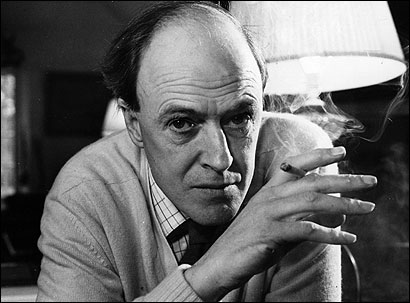
5. If I could meet any author living or dead I would want to meet either Roald Dahl or Mark Twain. Both are among my favorite authors, and I'd like to know how they wrote what they did; both just seem like interesting folks!

6. The next book on my "to read" list is a tough call. I'm deciding between 1984, Manhunt (on the Lincoln assassination), Dirk Gently's Holistic Detective Agency, and perhaps poking around some graphic novels. One thing's for sure: if I keep up with reading this summer I'll definitely be frequenting the library... well, frequently.


7. If I was snowed into remote cabin in the woods and could only choose three books to bring with me I'd bring Hamlet, The Ultimate Hitchhiker's Guide to the Galaxy, and the unabridged Les Miserables. Hamlet would be interesting to look through a few times from different angles; The Ultimate Guide because, well, how else am I going to bring all five Hitchhiker's books?? And Les Mis because I like the way Hugo writes, it just takes a long time to digest. And, at well over 1500 pages, depending on the publisher, it is long, man.

19 February 2010

The Hitchhiker's Guide: Radio vs. Print

I've recently picked up The Hitchhiker's Guide to the Galaxy again in an attempt to actually finish out the series. Now, I'm more-or-less familiar with the way the story works out, to a certain extent, mostly because I've listened to a majority of the radio series. However, with Restaurant officially finished I've crossed the threshhold from radio-based to originally-book storylines.
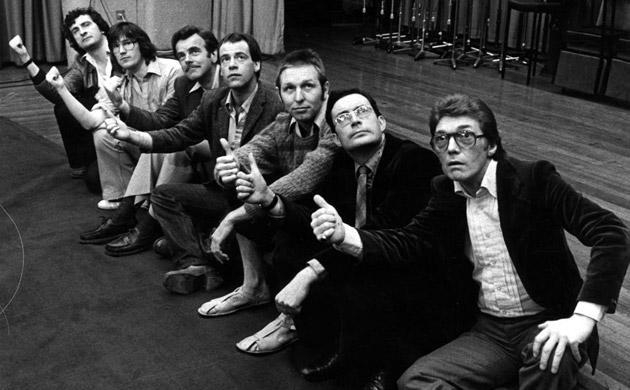
Just to add a little context, the first Hitchhiker's storyline came out through a radio series in 1978; a second season/series aired in 1980. These two together form the events found in the pages of The Hitchhiker's Guide to the Galaxy and The Restaurant at the End of the Universe. The books were released in 1979 and 1980, respectively.


In the interim between the radio broadcasts and the books' publication, Adams tweaked the storyline a bit. Admittedly I was a bit nervous when I first heard that the radio and books weren't the same in all spots. Would it be possible to keep the stories straight? Would one potentially ruin the other?


Of course, as the case usually seems to be with Adams, it all works out for the better. While I love the radio medium, and all the creative insanity it allows, the first two Hitchhiker's series got rather jumbled rather quickly. After the revelation about the mice and Earth's purpose (I'll try not to give anything away) the story gets very confusing. It's difficult to keep track of who's where and when, how people get from point A to point B, and even what's going on at points A and B, and how point C fits into everything. And, at times, it almost lacks in comprehensible detail. Something might be explained, or not, and even the explanation doesn't make sense in the whole grand scheme of the inaptly-named Trilogy in Five (now Six) Parts.


I'd like to think Adams picked up on this as well, and he had a chance to reorganize the story a little bit. He expanded and developed certain parts that were working well, reshuffled the characters to give more of a believable sequence of events, and indeed reorganized and trimmed out parts of the plot. In other words, certain parts appear only in the book, and other parts appear only in the radio series. All in all, though, they shake out and join up to meet Life, the Universe, and Everything. It's like Adams' own description of history, as spoken by Ford Prefect: "History is never altered you see, it just fits together like a jigsaw."


As far as which I prefer: honestly, both are fairly equal in merit. On the one hand, I'm a purist and wholeheartedly support a work in its original medium. I love audio, and the voices fit perfectly with the characters. I know there was a movie that came out a few years back, but as far as I'm concerned the only Arthur Dent is Simon Jones, and the only Ford Prefect is Geoffrey McGivern. (to hear both more-or-less side by side, take a listen here)


On the other hand, the books are much more detailed, especially in visual nuances that are unfortunately impossible in an audio-exclusive medium. Besides, Adams just has a way of describing things in an offbeat, deadpan, occasionally sensitive, and overall epic manner.

[Zaphod's grandfather's] two small wispy-haired heads looked so ancient that
it seemed they might hold dim memories of the birth of the galaxies
themselves.

Arthur Dent was grappling with his consciousness the way one grapples
with a lost bar of soap in the bath.


Nevertheless, like every other parking lot in the Galaxy throughout the
entire history of parking lots, this parking lot smelled predominantly of
impatience.

I mean, where else would you find that sort of thing?

Ideally, I would mix the auditory awesomeness of the characters with the detail and description of the books, but as that's not exactly possible, I'm perfectly content with giving equal merit to both and with going between the two for froody satisfaction.

26 January 2010

"It is said in death..."

The first part of this was my response to a Daily Writing prompt: take the first line of a book, any book, and use it as the first line of some writing. The second part (starting with "It's an odd sensation...") I wrote out of boredom.

It is said that in death, all things become clear...

Who said that? Somebody dead?

Listen, death is very confusing. It sees no need to tear away the veil of ignorance as you take your last breaths, especially if someone else introduced you to death.

As I lay there, gasping my last, nothing but questions raced through my mind. What had I done to deserve this fate? Why such cruelty?

And when I did die, how would I be able to make that sucker pay for staining the neckline of my new dress?

It's an odd sensation, looking at your dead self. So-called out-of-body experiences have nothing on this. At first it was a bit confusing to grasp: Wait, so, that's me there... but wait, aren't I here? Like, here, here? That's supposed to be there, but that can't possibly be me, I'm... right... here... right?

I spun in circles with that one for quite some time until I finally convinced myself that I was me, and that body that looked like me was just coincidentally similar in features. I was where my thinking was, I told myself, and usually dead bodies can't think for themselves.

That partial detachment made it a bit easier to give in to my curiosity and examine my dead self. The pale face didn't hold too much expression, but the mouth was drawn in a little with worry, and the brow was still wrinkled in concern. I was thankful I didn't die with my eyes open, that would've royally freaked me out. For some reason I'd often been complimented on my neck; apparently there was something regal about it. I half-chuckled spitefully, "Nothing regal about a sliced-open neck, I can say that much." It turned my stomach to look at it, but my curiosity got the better of me: my assailant had taken a few surprisingly deep hacks at my trachea. Below these awfully raw incisions, which I'd decided were as precise as incisions executed by a drunk surgeon on a pogo stick with a rusty machete, now-dried blood laced what had been my collar bone and seeped into the neckline of the dress I was wearing.

And to think, I realized, I'd been trying to pick out a necklace before I died.

03 January 2010

Dystopian Barbershop

[to be done in a lively barbershop style. Regular text is the lead voice, anything in parentheses is the other three voices. All rhythm and harmony under the lead is done in typical barbershop "bops", "oohs", and "ahhs". Finger snaps are optional.]

A new world order's taken hold
(ooh, new order's taken hold)
Promised all they had hearts of gold
(bah bah, heart of gold!)

Took a little walk down the gov'ner's street,
And they took the power in a coup so neat.
Assured us all it was gonna be fine,
But then sent all our liberties to the bread line
(That bread, bread line!)

Made some big changes to the way we live
(Every night at eight they lock us in)
Everything is watched, that's no way to live.
(Oh no, no way to live)

Music ain't free, they say it just won't do,
So if they found us out, then we'd be through.
No more barbershop, ain't that a shame?
We got this dystopia to blame.
(Dystopian government we have to blame)

Waitin' and lookin', tryin' us to find,
(we're in hiding, trying us to find)
But just thus far to us they're blind
(Just like bats, they're just so blind).

We're hoping we can shake'm, keep ourselves alive
(Livin' and breathing, keep ourselves alive)
And keep the barbershop tradition buzzin in the hive
(Buzzin like bees, keepin' tradition alive)

- - - - - -


I asked for a random prompt, the supplier gave me "dystopian barber shop." I interpreted it to be "barbershop" as in the kind of quartet; this one was a thinker, lemme tell you.
I think this stands as proof as to why I shouldn't write "late" at night.

12 December 2009

Random Apostrophic Letters from the Pianist

A take off of a semi-feature on Robyn's blog...
- - - - -
Dear Connor,
It's been a while, I know. I want to continue your story, but you've been out of my head for a while. Please, will you come back? I really do miss you. You and this story of yours has been too enjoyable for you to stay out much longer. If you need a break, I understand, but can you at least assure me you'll come back sometime in the foreseeable future?
Missing you,
~g2

A telegram addressed to My Living Quarters:
Enough is enough. Stop. Upon my return this evening prepare for an intense excavation. Stop. Although I will be exhausted from my piano lesson no mercy will be shown. Stop.

You have been warned. Stop.

Querida amiga,
He pensado mucho en tí recientamente. Mientras sienta un poquitin raro en una parte de mi mente que estás con alguien, estoy alegre para tí. El es inteligente, maduro, y fuerte y franco en sus opiniones, y son buenas calidades, pienso. Las fallas solas que puedo encontrar en él: lleva casi demaciado negro, y a veces habla entre dientes. Pero, no son detalles enormes, creo. Espero que cosas pasen bien para ustedes. De todos modos digo que has escogido bien.
Siempre aquí,
~g2
PS: Yay for chances to use subjunctive! ^^


My dearest Oliver,
Thank you so much for helping me prepare everything: the competition a few weeks ago, my audition yesterday, and the other auditions to come. I'll certainly miss you next year, but I'll be close enough that I can come home to you easily.
Between you and The Piano Teacher I can't thank you enough. You two have been all too good to me.
Much love,
~g2

To: Gen. Nonsense
First, I've some disappointing news to report. I've done some digging, and I believe that majors are indeed higher than captains. I admit that it's a bit disheartening to think that Disaster, Third, and especially Distraction are all ahead of me... and to think! I'm the oldest in the rank! Ah well, it is what it is.
Second, as far as chronicling our group goes: I was thinking we could describe the members and then decide on various episodic adventures. We can brainstorm, yes?
Third: bink.
~Cpt. Obvious

Paulito & Nikki,
I just wanted to thank you guys for being such hoopy writing friends, and indeed hoopy friends in general. Distance may separate us three, but that has yet to be a real deterrent. I've missed talking with you two as of late, but I hope fate decides to allow our paths to cross again very, very soon.
Not panicking,
~g2

07 December 2009

On Criticism

I'm not usually one for rants, but with a competition in the not-too-distant past and my college auditions starting up this week (!!!) the subject's been on my mind, asking to be ranted about a bit. And that has been the subject of criticism.

Yes, almost everybody cringes at the word and others in its family (criticize, critic, critique, etc), but I'm pretty well used to it. I have to be, the arts and music especially are subject to such scrutiny.
Whatever the definition, I frankly don't mind it; for the most part it's advice that will help me improve my work, presented in a fairly nurturing way that doesn't label rough spots as FAILURES but as things to work on. Not only that, but more often than not the criticism is given by either a peer or someone who is more experienced than I in a particular area, usually the piano.
Two particular things bother me about criticism, though. Of course there would be something that bothered me about it, otherwise this wouldn't be a particularly good rant.
The first is its negative connotation. According to our good friend N. Webster, the first definition of "criticize" runs as follows:

"crit-i-cize: verb, 1: to consider the merits and demerits of and judge accordingly, evaluate."


I think negative association in the media is to blame for this one. People often times are afraid of having their mistakes pointed out to them, myself included. Folks are also hesitant to point out mistakes to others, for fear of offending them somehow with the criticism. Criticism, while it does point out faults, does not mean that just because one bit needs some work the whole thing is a disaster. It's okay to both be criticized and to criticize...

...to an extent.
I'm hesitant with this because of the other bothersome point. Usually to properly evaluate/critique something, the critic needs equal, comparable, or greater experience in the evaluated field, preferably one of the latter two. Experience gives a critique merit; I'm more likely to give the comments of a piano conservatory professor a little more consideration than the comments of, say, a passing counter clerk with little classical music background. However, some people just slash through others' work without much experience in that particular work.

I automatically think back to our school's talent showcase last year on this subject. After I played, I scooted into the auditorium to see the rest of the acts with a handful of friends. Immediately behind us, however, was somebody who sounded like he was trained by Simon Cowell himself. From the time I sat down to the end of the show, I don't think The Critic had a single positive thing to say about any of the acts. I'm not saying The Critic didn't say anything positive; if TC did say something positive I didn't hear it.


What particularly irked me about this Critic was the tone, the tone of assumed omniscience. Most of the acts were musical groups, and while there's a large musical population in our school, I don't think this particular Critic is among that population. The trouble is, TC commented as if drawing inspiration from some Exhaustive Encyclopaedia of Musical Perfection. Just the condescending tone made me want to whip around and hiss, "then let's see you get up on stage and perform the song that you wrote in front of 70-some-odd people." Unless this person is some kind of closet prodigy with an infinite wealth of knowledge in music composition and performance, because of a lack of experience I honestly don't think The Critic had any right to assume this know-it-all role. It's fine to say why you like or don't like a particular work, but trying to sound like an authority just doesn't cut it.
The right to criticize authoritatively falls under the same rules as bragging rights, in my book: if you can't match it, top it, or offer any advice to improve it, you've no real right to criticize it.

07 November 2009

The Traveler Returns

Howdy all! I just got back from my insanely amazing trip 'round Europe, complete with pictures, commentary, temporal confusion (my body thinks it's three in the morning, but my brain hasn't a zarkin' clue as to location yet, much less time), a touch of aircraft-induced-dizziness (it got bumpy around Greenland), but a great sense of satisfaction.
Will I let you all in on what went down across the pond? Of course! That's what I promised, isn't it? However, all y'all are going to have to hang in some suspence for a while; I still have schoolwork and serious piano catch-up to contend with, as well as actually typing up the aforementioned commentary and loading in the previously-alluded-to pictures. These things take time, you know!
However, I will do my best to deliver as soon as I can!

30 October 2009

DON'T PANIC: It's Just a War of the Worlds

Turn back the clock to late October, 1938. Actor Orson Wells was lining up sci-fi radio plays for his Mercury Theater on the Air. He went through a few ideas, but none of them seemed to be working. Finally, somebody asked "How about this?" and pulled out the book War of the Worlds.
Wells was reluctant to adapt the work to the radio. Not because he was afraid of causing mass hysteria, but because he found the story "dull." The book had been around for 40 years, it had been adapted to several adventure stories and comic books by this time. Most people were familiar with this story, he thought. Finally he agreed to do it. But they had to update it before they went on the air.

Now, fast forward to 8 pm on Sunday, October 30th. A small number of radio listeners tuned into the Mercury Theater on the Air and heard the play's introduction, announcing that night's play as H.G. Wells' War of the Worlds. However, most people were tuned into the immensely popular Chase and Sanborn Hour, and missed the crucial intro. The first four minutes or so went well, but then at approximately 8:05, a rather unpopular singer came on the show. So people began to dial surf, and as it happened most people landed on the Mercury Theater on the Air first, already in progress. But when they landed on it, it sounded like a regular music show. Then, after a little musical interlude, a voice cut in: "We interrupt this program to bring you this news bullitin..."

Now, it should be mentioned at this point that news breaks were fairly new, and extremely frequent, in the late 1930's. Most news breaks at the time ran bullitins having to do with the Nazis, who had been slowly overtaking Europe. Naturally, Americans had been growing nervous about the Nazis, and there were only a few ways to get the news, radio often being the fastest.
The War of the Worlds news break reported that the Princeton Observatory had observed gas explosions on the surface of Mars at regular intervals, but the station would keep the audience updated should anything else be found. "And now back to the music of Raymond Roquello and His Orchestra."

Most people found this break to be a bit odd. Explosions on Mars? How strange. And who was this Raymond Roquello guy? Not really thinking much of it, folks sat back and relaxed again. But then about a minute later, another news break comes through: The Princeton Observatory had just reported the landing of a meteor in rural Grover's Mills, New Jersey, and had schedualed an interview with one of the Observatory's astronomers.

Now people were starting to get suspicious. What in the world was going on? Most people claimed they didn't believe the story too much, until they heard several "expert" opinions of the situation. The way the show was formatted, with the breaks over the music program, the authoritative commentary, made it sound completely legitament. Folks were lost inside the newscast.

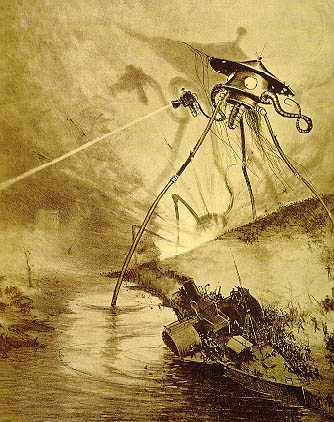
Finally the update cut to a field report in Grover's Mills, where the meteor had landed. The reporter and an astronomer are describing the events unfolding before their eyes: the meteor had fallen away, revealing a metal pod definitely of alien origin. After a few tense moments, the pod begins to open, revealing a hideous slimy creature; muffled shouts could be heard in the background. Then, out of nowhere, the reporter begins to flip out: the creature has just vaporized knot of military personell.

The reporter's panic sounded completely real, and oddly familiar. A year before, many people had heard the now-immortal cry of "Oh, the humanity!" in response to the Hindenburg disaster. The actor playing the reporter had actually found a tape of this report and listened to it repeatedly, so he could get into the right frame of mind for the attack scene.
Seconds later, without warning, the field report cuts out. Soon after, it is reported that the pod has sprouted tree-high legs and was marching through the New Jersey countryside, crushing anything in its path. This is where people really started to panic, although they didn't think "We're being attacked by Martians." Their first thought was, "We're being attacked by Germans."

The show continued on in the same way, as a string of news reports come in announcing that more Martians were landing and slowly taking over New Jersey and surrounding areas, taking out armies with a poisonous gas. At one point later in the broadcast the news announcer dejectedly states that "everything [was] wiped out."

About 12 million say they got the joke. But the majority of the American public didn't. No one knows exactly how many people panicked that night. However, there are a few certain numbers: The Trenton police department receieved 200 calls in under two hours. The New York Times switchboards were inundated with 875 calls alone, which were mostly people wanting to know where they would be safest. A study conducted shortly after the broadcast found that some people reported they actually felt like they were choking, a handful claimed they saw a veil of smoke over Manhattan from the battle in nearby Jersey, and some swore they spotted a marching Martian pod or two.
After the broadcast, and learning of the mass hysteria, Orson Wells held a press conference, in which he said this:

"The War of the Worlds has no further significance than as the holiday offering
it was intended to be. We annaihilated the world before your very ears, and
utterly destroyed the CBS. You will be relieved, I hope, to learn that we didn't
mean it, and both institutions are open for business."


In short: It was all a joke. Wells expressed great surprise that such a familiar story could cause such panic when the format was changed up a bit. Unfortunately the public and the FCC didn't find the situation funny, the FCC so much so that the comissioner shortly thereafter labled Wells and his Mercury Theater on the Air as "radio terrorists."

As if that wasn't enough, events similar to this have happened twice since 1938: once in Quito, Ecuador, in 1949, and in our own Buffalo, NY, in 1968. The format was that of a regular DJ show on WKBW, with a interruption format very similar to the original 1938 broadcast. The outcome was very similar as well: the station received 2,000 calls, 47 newspapers nationally reported the incident, even a portion of the Canadian army was dispatched to the border bridges to fend off the Martian invadors.

People, by nature, are hard-wired to latch onto stories and to follow them through to the end. Unfortunately some miss the crucial beginnings and misinterpret the whole thing.

25 October 2009

I think you ought to know...

If you start to hear a whole lot of nothing coming from my direction, don't worry.
Or, if you're likely to skip the worry phase and go straight to the panic phase, I would recommend you follow this advice:


I haven't fallen off the edge of the earth....


... I haven't been overtaken by robots


... or anything of that sort.

No, I'm just going to be galavanting around Europe, specifically through Portugal, Spain, and a little bit of France, and hopefully with at least a small towel in tow.

I'll be back the first week of November, don't you worry. And when I do return, there will be photos. There will be commentary. And there will most likely be Spanish outbursts.

You have been warned.

26 September 2009

Perhaps My Highest Compliment

So there's a thread going on Protagonize called "My Name I Skate." It's a collection of altered, contorted, or otherwise tweaked Protagonists' pennames. I found them all very amusing, but I figured that, given the bizzare and lengthy complexity of my own penname, no one would try to take mine on.

And, as per usual when I think those sorts of things, I was proven wrong.

The perennially excellent Tasha Noble left me a message on my Protag profile a few days ago.
"Apologies in advance!" she began, "But I couldn't resist it. And it's very silly indeed." Naturally I had no idea what she was talking about, so I curiously clicked the included link, which led me to this:

Gee! to Lappy-Annie Stairland (E.S.A)
Gee! What a funny girl is Annie Stairland

Working for the Ecological Society
Of America, with her laptop-case in hand
She's never seen without it - loves it very much, you see.

At night she keeps her lappy in a lead-lined strong-box
In her bedside cabinet, and guarded by her dog
(A doberman-rottweiler cross whose name is Mr Cox)
Because of these precautions Annie sleeps like a log.

She keeps all her contacts in her 'lappy', and she would
Be completely lost without it so it never leaves her side
It's how she got her nickname, but I really think she should
Invest in a netbook, They're much easier to hide.

I couldn't believe it. I couldn't help but laugh aloud; it was so funny and so ingenious, and I still couldn't get over the fact that she'd somehow managed to tweak something out of my penname. Granted, the "g2" is supposed to be "g-squared," but she told me that it wouldn't of worked otherwise.

I found some of the other feedback:

"Wow Tasha, you really contorted g2's name into shape there. From now on we should call you Tasha: Lyrical Contortionist!Nice work, very funny."

"Even if the poem sucked, I would have had to give you an A+ for managing something out of the Irish Pianist's name. But such was not the case :D"

"wow, till I read Aryst0's comment I had no clue who this was about... but it's pretty fantastic.I'm in a public computer room at my college laughing away to this things. Pretty soon I'm gonna be getting looks.. if I'm not already. I don't exactly care. haha."

Naturally, I had to add my own two-cents:
"Okay, those two poems earlier made my morning, but this just made my whole zarkin' week, Tasha. It took a while to see it, but as soon as I did I had to laugh aloud. I have [no] clue how you did it, but boy you did it."

Somehow, in my mind, the hilarious contortion of my name ranks as probably the highest compliment I have ever received on Protag.

Thanks muchly Tasha.