11 August 2010

On Collaboration

Writing is usually thought of as a solitary pursuit, and to a certain extent it is.  One can't exactly write while carrying on a conversation, or in a restaurant among a bunch of people.  However, it's something one can't do completely by oneself.  One needs feedback, support, inspiration... and, after all, a writer needs readers!  One should write for the sake of writing, but that writing's written for somebody to read.

I've come across a few good places to find feedback for my writing.  Yes, blogging's alright, but it's tough to find wide readership if it's thrown out for the general internet population to happen upon.  But, if work is put out for a narrower audience odds are someone's more likely to find it and appreciate it.

Way back when I discovered the writing site ficlets.  The idea was to craft story bits, or just smaller writing pieces, between 64 and 1024 characters in length.  It doesn't seem like a sufficient length to do anything significant, but it was impressive what people could conjure.  The following is an old piece of mine:
Sigh.

It felt like only yesterday that we met.
Something just seemed to click.
We had the same sense of humor, could understand each other’s quirks.
I can’t recall when I’ve had such interesting conversation with someone (who is not related to me, that is).
(Then again, there are all those other similarities, so there is that possibility.)

Alas…

Alack…

There is so much we can’t see.

Words can only go so far, you know.

I’ve never seen your face.
I’ve never heard your laugh.
I’ve never seen a smile grace your lips.

We’re separated by an unseen barrier of time.
A wall of space.
A web of wires.

But I guess that’s what the imagination is for, isn’t it?

I can only guess what you look like.
What you sound like.
And you can do the same about me.
Our friendship linked by words.
If only we could finally meet.
If only to be friends.

But for now, as I type, I’ve decided:
For now, I can let my imagination satisfy me.

Because that’s what the imagination is for, isn’t it?
http://ficlets.ficly.com/stories/43467
Not only was it amazing what one could do in a short space, but the community was what truly astounded me.  Most folks tried to look out for everyone else, giving feedback and otherwise supporting each other in their writerly endeavors.  We were a very tight-knit community.... until AOL pulled the plug on the site in January of 2009.

One of the original developers of the site, Kevin Lawver, resurrected the idea in a new independent site, ficly.  It's essentially the same idea, very short pieces, and again with some old ficlets vets and new recruits it's up and thriving.

In the interim between ficlets' death and ficly's birth I discovered Protagonize, a similar community without the character limit.  It was intimidating at first, but after a slightly bumpy start I got right into it and I haven't looked back.  The folks are great, the pieces are good, it's overall been a great experience.

Most recently, however, I've discovered the awesomeness that is local feedback.  I've found a good support group in two friends from my English class and my physics teacher, of all people, who're all working on some project or other.  We've deemed ourselves The Fellowship, and thus far I'd say we've been working very well together.  We're looking over each others' projects, offering feedback on those projects, and overall support.  We'll see if we can still work with three of us slightly sprawling at different schools next year.

Basically, I've found that while the actual act of writing's fairly solitary, the surrounding processes of support and communication shouldn't be so.  Sounding boards are great.

29 May 2010

Back to Basics

Alright, so I've gone back to the first background I ever used for this blog, with the intention of probably updating it.

We'll see how that goes, though.

12 May 2010

Why Can't We Compromise

Why must we choose one way or the other?
Why can’t we compromise?
What if someone is torn between choices?
What if that person can’t decide?


Why must we choose one way or the other?
Why can’t we compromise?
Should (s)he not decide at all?
But what if (s)he wants to make a difference?

Your Choice
http://www.flickr.com/photos/44124372363@N01/2226577438/

Why must we choose one way or the other?
Why can’t we compromise?
Why must it be just “circle” or just “rectangle,”
If one equally agrees with both?
What if one is for the arch of the circle,
But also the straight path of the rectangle?


Why must we choose one way or the other?
Why can’t we compromise?
Why can’t there,
just for once,
be an oval?
- ~ - ~ - ~ - ~ - ~ - ~ - ~ - ~ - ~ -
I rediscovered this little piece in my ficlets memorial, originally here.

07 May 2010

Blankity Blankity Blank

So: one of the handful of blogs I follow, my sweet old etcetera, does a fill-in-the-blank every Friday (which the blogger, the wonderful Annie Cristina, gets from a different blog with which I'm not familiar), and this week's intrigued me, seeing as it's about books.

I thought I'd share my answers:
1. My favorite book growing up was Zebra's Hiccups by David McKee. I think it might've been that my dad did the voices and fake hiccups very well.
2. The funniest book I've ever read was probably The Hitchhiker's Guide to the Galaxy, as in the first one. Maybe it's because it's more recent, but that was the first book to make me laugh so hard that I actually had to put it down in a very, very long time. Such is life for an English student, most books of "literary merit" aren't particularly uplifting.


3. The one book that truly changed my life was Les Miserables. I don't know what it was, but there was just something about that book that really struck me.

4. If you're looking for a real "tear-jerker" you should probably read... Elie Wisel's Night, perhaps? I don't know, it certainly struck me hard. I don't really go looking for tear-jerking books all that often; the works we read for class are often depressing enough.


5. If I could meet any author living or dead I would want to meet either Roald Dahl or Mark Twain. Both are among my favorite authors, and I'd like to know how they wrote what they did; both just seem like interesting folks!

6. The next book on my "to read" list is a tough call. I'm deciding between 1984, Manhunt (on the Lincoln assassination), Dirk Gently's Holistic Detective Agency, and perhaps poking around some graphic novels. One thing's for sure: if I keep up with reading this summer I'll definitely be frequenting the library... well, frequently.


7. If I was snowed into remote cabin in the woods and could only choose three books to bring with me I'd bring Hamlet, The Ultimate Hitchhiker's Guide to the Galaxy, and the unabridged Les Miserables. Hamlet would be interesting to look through a few times from different angles; The Ultimate Guide because, well, how else am I going to bring all five Hitchhiker's books?? And Les Mis because I like the way Hugo writes, it just takes a long time to digest. And, at well over 1500 pages, depending on the publisher, it is long, man.

19 February 2010

The Hitchhiker's Guide: Radio vs. Print

I've recently picked up The Hitchhiker's Guide to the Galaxy again in an attempt to actually finish out the series. Now, I'm more-or-less familiar with the way the story works out, to a certain extent, mostly because I've listened to a majority of the radio series. However, with Restaurant officially finished I've crossed the threshhold from radio-based to originally-book storylines.
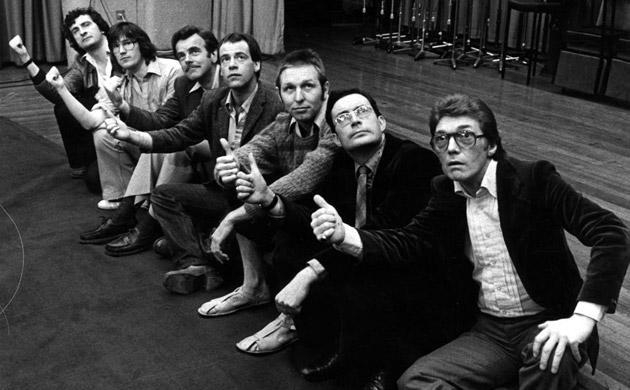
Just to add a little context, the first Hitchhiker's storyline came out through a radio series in 1978; a second season/series aired in 1980. These two together form the events found in the pages of The Hitchhiker's Guide to the Galaxy and The Restaurant at the End of the Universe. The books were released in 1979 and 1980, respectively.


In the interim between the radio broadcasts and the books' publication, Adams tweaked the storyline a bit. Admittedly I was a bit nervous when I first heard that the radio and books weren't the same in all spots. Would it be possible to keep the stories straight? Would one potentially ruin the other?


Of course, as the case usually seems to be with Adams, it all works out for the better. While I love the radio medium, and all the creative insanity it allows, the first two Hitchhiker's series got rather jumbled rather quickly. After the revelation about the mice and Earth's purpose (I'll try not to give anything away) the story gets very confusing. It's difficult to keep track of who's where and when, how people get from point A to point B, and even what's going on at points A and B, and how point C fits into everything. And, at times, it almost lacks in comprehensible detail. Something might be explained, or not, and even the explanation doesn't make sense in the whole grand scheme of the inaptly-named Trilogy in Five (now Six) Parts.


I'd like to think Adams picked up on this as well, and he had a chance to reorganize the story a little bit. He expanded and developed certain parts that were working well, reshuffled the characters to give more of a believable sequence of events, and indeed reorganized and trimmed out parts of the plot. In other words, certain parts appear only in the book, and other parts appear only in the radio series. All in all, though, they shake out and join up to meet Life, the Universe, and Everything. It's like Adams' own description of history, as spoken by Ford Prefect: "History is never altered you see, it just fits together like a jigsaw."


As far as which I prefer: honestly, both are fairly equal in merit. On the one hand, I'm a purist and wholeheartedly support a work in its original medium. I love audio, and the voices fit perfectly with the characters. I know there was a movie that came out a few years back, but as far as I'm concerned the only Arthur Dent is Simon Jones, and the only Ford Prefect is Geoffrey McGivern. (to hear both more-or-less side by side, take a listen here)


On the other hand, the books are much more detailed, especially in visual nuances that are unfortunately impossible in an audio-exclusive medium. Besides, Adams just has a way of describing things in an offbeat, deadpan, occasionally sensitive, and overall epic manner.

[Zaphod's grandfather's] two small wispy-haired heads looked so ancient that
it seemed they might hold dim memories of the birth of the galaxies
themselves.

Arthur Dent was grappling with his consciousness the way one grapples
with a lost bar of soap in the bath.


Nevertheless, like every other parking lot in the Galaxy throughout the
entire history of parking lots, this parking lot smelled predominantly of
impatience.

I mean, where else would you find that sort of thing?

Ideally, I would mix the auditory awesomeness of the characters with the detail and description of the books, but as that's not exactly possible, I'm perfectly content with giving equal merit to both and with going between the two for froody satisfaction.

26 January 2010

"It is said in death..."

The first part of this was my response to a Daily Writing prompt: take the first line of a book, any book, and use it as the first line of some writing. The second part (starting with "It's an odd sensation...") I wrote out of boredom.

It is said that in death, all things become clear...

Who said that? Somebody dead?

Listen, death is very confusing. It sees no need to tear away the veil of ignorance as you take your last breaths, especially if someone else introduced you to death.

As I lay there, gasping my last, nothing but questions raced through my mind. What had I done to deserve this fate? Why such cruelty?

And when I did die, how would I be able to make that sucker pay for staining the neckline of my new dress?

It's an odd sensation, looking at your dead self. So-called out-of-body experiences have nothing on this. At first it was a bit confusing to grasp: Wait, so, that's me there... but wait, aren't I here? Like, here, here? That's supposed to be there, but that can't possibly be me, I'm... right... here... right?

I spun in circles with that one for quite some time until I finally convinced myself that I was me, and that body that looked like me was just coincidentally similar in features. I was where my thinking was, I told myself, and usually dead bodies can't think for themselves.

That partial detachment made it a bit easier to give in to my curiosity and examine my dead self. The pale face didn't hold too much expression, but the mouth was drawn in a little with worry, and the brow was still wrinkled in concern. I was thankful I didn't die with my eyes open, that would've royally freaked me out. For some reason I'd often been complimented on my neck; apparently there was something regal about it. I half-chuckled spitefully, "Nothing regal about a sliced-open neck, I can say that much." It turned my stomach to look at it, but my curiosity got the better of me: my assailant had taken a few surprisingly deep hacks at my trachea. Below these awfully raw incisions, which I'd decided were as precise as incisions executed by a drunk surgeon on a pogo stick with a rusty machete, now-dried blood laced what had been my collar bone and seeped into the neckline of the dress I was wearing.

And to think, I realized, I'd been trying to pick out a necklace before I died.

03 January 2010

Dystopian Barbershop

[to be done in a lively barbershop style. Regular text is the lead voice, anything in parentheses is the other three voices. All rhythm and harmony under the lead is done in typical barbershop "bops", "oohs", and "ahhs". Finger snaps are optional.]

A new world order's taken hold
(ooh, new order's taken hold)
Promised all they had hearts of gold
(bah bah, heart of gold!)

Took a little walk down the gov'ner's street,
And they took the power in a coup so neat.
Assured us all it was gonna be fine,
But then sent all our liberties to the bread line
(That bread, bread line!)

Made some big changes to the way we live
(Every night at eight they lock us in)
Everything is watched, that's no way to live.
(Oh no, no way to live)

Music ain't free, they say it just won't do,
So if they found us out, then we'd be through.
No more barbershop, ain't that a shame?
We got this dystopia to blame.
(Dystopian government we have to blame)

Waitin' and lookin', tryin' us to find,
(we're in hiding, trying us to find)
But just thus far to us they're blind
(Just like bats, they're just so blind).

We're hoping we can shake'm, keep ourselves alive
(Livin' and breathing, keep ourselves alive)
And keep the barbershop tradition buzzin in the hive
(Buzzin like bees, keepin' tradition alive)

- - - - - -


I asked for a random prompt, the supplier gave me "dystopian barber shop." I interpreted it to be "barbershop" as in the kind of quartet; this one was a thinker, lemme tell you.
I think this stands as proof as to why I shouldn't write "late" at night.